Back to the terminal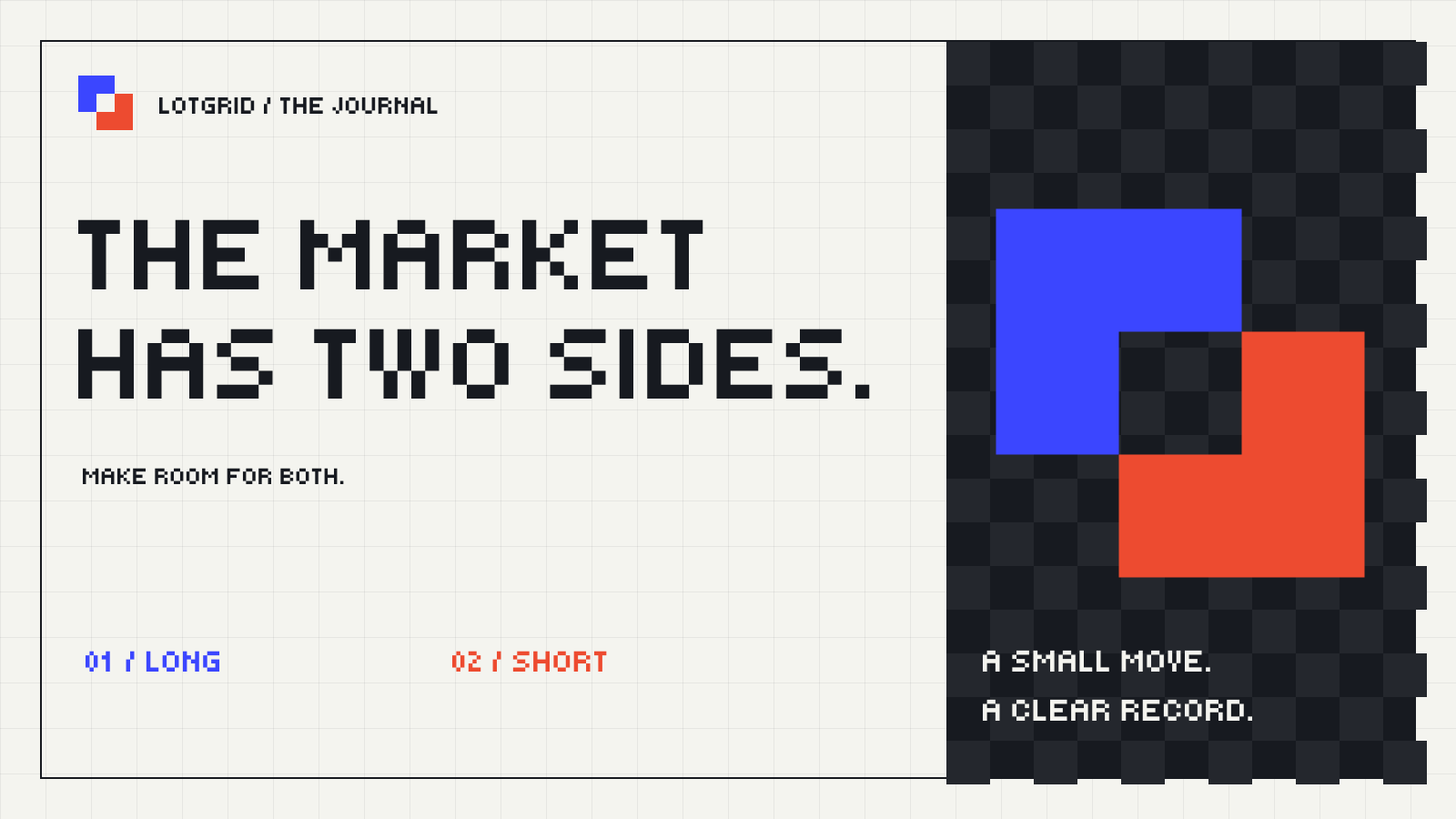
The market has two sides. Make room for both.
Markets change direction. The interface should make the decision clear. LOTGRID brings long and short into one deliberately compact workspace: a live chart in the center, a watchlist on the left, an order ticket on the right, and a record of each paper position below.
A desk made of small moves
The name combines a trading lot with a grid. The identity starts with two opposing pixel blocks that lock together. Blue belongs to long. Vermilion belongs to short. Fine graph-paper lines and firm black rules organize the numbers without turning the screen into a collection of generic cards.
A short introduction assembles the mark before opening the terminal. It can be skipped, replayed, or reduced with the device’s motion preference. The same geometric language continues through the buttons, typography and motion film.
Real observations, a paper balance
LOTGRID reads public market metadata, candlesticks and order-book snapshots from Hyperliquid. The selected market shows its price, 24-hour change, volume, open interest and hourly funding rate. Candles can be viewed from one minute to one day. The funding rate is information only; funding payments are not part of the paper engine.
The account starts with $10,000 in simulated funds. No wallet, deposit or real order is involved. Choose a market, decide on a direction, set the paper margin and select leverage within the desk’s supported range. Review the position size, estimated quantity, simulated entry fee and simplified close-out level before submitting.
Every decision leaves a receipt
Market orders use the latest available quote. Limit orders reserve their margin and entry fee, and fill when a fresh quote crosses the chosen level while the page is open. Pending orders can be cancelled to return those reserved funds.
Positions show entry, margin and unrealized profit or loss. Closing a position records its result after simulated fees. Take-profit and stop-loss levels can be set at entry. History stays in the current browser and can be exported as a CSV.
Know what the model leaves out
This is a paper execution model, not a trading venue. It charges a simulated 0.05% per fill and does not model slippage, market impact or funding payments. Protection orders are checked only while the page is open. Gaps can pass the requested level. The 90% margin-loss close-out trigger is a simplified paper rule, not Hyperliquid’s liquidation calculation.
Data interruptions disable new orders until a fresh quote arrives. Local storage is device-specific: clearing it removes the account record. LOTGRID is independent and does not imply an affiliation with Hyperliquid.
Two directions. One desk. A clearer way to practice the decision and keep its record.
Market data documentation: Hyperliquid Info endpoint.